Rabbi Philip Weintraub
Parshat Bo
January 18, 2012
Good evening,
It
is so nice to see you here on a Shabbat evening. For me, Friday night
is one of my favorite times. While for me, the most stressful part of
my week can be Shabbat, Friday night is a time when our gears shift. We
change from the hustle and bustle of the week to a different avir,
a different atmosphere. On Friday night, we come together as a family.
We light candles. We drink wine. We, hopefully, enjoy dinner
together. We bless our children and our spouses. In creating this time
together, we pause from our hectic lives to acknowledge our gratitude.
No
matter how stressful, no matter how sick we get, no matter what
challenges we are dealing with on a regular basis, we are lucky. We
live, as Jews, in America, in the 21st century. There is no time like
the present. We have more opportunities, benefits, mitzvot
as American Jews or Jewish Americans than anywhere else. While we
haven’t seen a Jewish president, we have seen candidates for VP and many
high offices, some of whom have also demonstrated that they could be
observant of the Sabbath AND serve the country.
So
this Shabbat and every Shabbat is a time for thanks. It is a time to
remember that even Gd, who can do anything at anytime, rested. Did Gd
rest because Gd needed rest, NO!? Gd rested to demonstrate to us that
we, human beings need a break now and then. Gd rested to demonstrate to
us that no matter our situation, we can and should take some time, to
power down, see our family and enjoy a little peace and quiet.
Shabbat
is also a time for education. We can read Jewish texts or secular
texts. We can discuss issues of today or yesterday. We can look at the
world around us and consider the blessings of this world.
In this week’s parsha, Bo, we read about the preparations for leaving Egypt.
Chapter 12
24
"You shall observe this as an institution for all time, for you and for
your descendants. 25 And when you enter the land that the Lord will
give you, as He has promised, you shall observe this rite. 26 And when
your children ask you, 'What do you mean by this rite?' 27 you shall
say, 'It is the passover sacrifice to the Lord, because He passed over
the houses of the Israelites in Egypt when He smote the Egyptians, but
saved our houses.'"
From
the very beginning of our traditions, education has been central. Why
do you think that Jews have been so successful in this world? Given the
opportunity, education, secular and religious has been a central value
for most Jews. We have said to our children, ask questions, think about
the world around you. Do not accept the status quo, but challenge it,
change it, imagine what the world could look like with your stamp on it!
In our Torah, when talking about the rituals of Passover, the Torah
says “When your children ask you. . .” This is a big assumption. While
it seems that children naturally ask questions, this skill must be
cultivated. Children must be challenged, encouraged, excited to ask
questions. This takes parental interest and involvement.
This
is what I pray I will be capable of with my daughter. I pray that when
she asks, I will say, “Let’s look it up together” rather than, “shush,
I’m busy.” I pray that I will investigate the world more through her
eyes. I pray that I will make Shabbat a special time for her, so that
she always looks forward to it.
I
pray the same for you. Tonight was not exactly what we had planned.
Next month we will have dinner, but it is important for things not to
work out sometimes. We cannot appreciate what does work without the
occasional reminder that not everything works. Imperfection helps us
appreciate when things do work out. Tonight was a lovely evening. It
is nice to see you here and I pray we will have many, many more Friday
nights together. If you would like to do this more than once a month,
please tell me, so we can make it happen!
Shabbat Shalom.
Friday, January 18, 2013

Friday, January 11, 2013
Not freedom FROM, but freedom TO
Parshat Vayera
Rabbi Philip Weintraub
January 12, 2013
This week’s parsha is famous for the plagues. Whether on Pesach or year round, it makes for a great story. Pharaoh is stubborn (whether with Gd’s help or independently), but through a series of miracles and punishments, Pharaoh decides to let our people go. At least for a moment, then a plague ends and Pharaoh says, “No, wait, stay!”
Relating to Passover, this parsha is also famous as the source of the four cups of wine. Each cup is seen to come from verses 6 and 7 of the 6th chapter of Shmot
These two verses from Sh’mot (Exodus) declare liberation 4 times:
1. I will take you out [והוצאתי] from the labors of the Egyptians
2. I will deliver you [והצלתי] from their slavery
3. I will redeem you [וגאלתי] with an outstretched arm and with great judgments
4. I will take you [ולקחתי] to be My people, and I will be your G-d.
Some, who say we are ready for the fifth cup of wine at Passover, also include
(The debate about that line is if Gd has given us Israel yet in all senses. Some argue that the State of Israel is this embodiment, others say we must wait for Messiah.
Yet even with these famous ideas, within one of these verses, I see a reminder of a verse from last week
Chapter 5:1
Last week we saw that Moses asked Pharaoh for freedom FROM Pharaoh so that we might have freedom TO worship Gd. This week we see see that Gd will redeem us and then take us as Gd’s people.
While I was in Israel, I studied with Rabbi Matthew Berkowitz, a JTS rabbi and educator in Israel. This week he shared a comment of Joseph B’khor Shor, a 12th century French rabbi, who wrote a commentary on the Torah.
It is said that every rabbi/teacher/preacher/minister has only a few sermons, but they share them over and over again in different ways. For me, one of my key messages is that in Egypt we were not freed FROM Pharaoh, but freed TO serve Gd. Thus our lives are not just a gift but an obligation. We have responsibilities as human beings, as Jews. As human beings we have responsbilities to the planet, to each other, to humanity. As Jews, we have the Mitzvot, we have the commandments, which help us to fulfill those Gd-given responsibilities. We are not free to live our lives and do whatever we wish, but are here to serve Gd. Repeatedly in the book of Judges, it says that “they had no King, every man did what was good in his eyes.” This was not a compliment but a failing. Sometimes we do what we think is right, but find it is not so. This is not the most popular message, but it is an important one. Our tradition, our heritage, our inheritance, our Judaism, offers us with a guide to life. It is all of these things, but only if we take it, only if we accept it, only if we live it. Shabbat Shalom.
Rabbi Philip Weintraub
January 12, 2013
This week’s parsha is famous for the plagues. Whether on Pesach or year round, it makes for a great story. Pharaoh is stubborn (whether with Gd’s help or independently), but through a series of miracles and punishments, Pharaoh decides to let our people go. At least for a moment, then a plague ends and Pharaoh says, “No, wait, stay!”
Relating to Passover, this parsha is also famous as the source of the four cups of wine. Each cup is seen to come from verses 6 and 7 of the 6th chapter of Shmot
ו לָכֵן אֱמֹר לִבְנֵי-יִשְׂרָאֵל, אֲנִי יְ-ה-וָ-ה, וְהוֹצֵאתִי אֶתְכֶם מִתַּחַת סִבְלֹת מִצְרַיִם, וְהִצַּלְתִּי אֶתְכֶם מֵעֲבֹדָתָם; וְגָאַלְתִּי אֶתְכֶם בִּזְרוֹעַ נְטוּיָה, וּבִשְׁפָטִים גְּדֹלִים.
| 6 Wherefore say unto the children of Israel: I am the LORD, and I will bring you out from under the burdens of the Egyptians, and I will deliver you from their bondage, and I will redeem you with an outstretched arm, and with great judgments; |
ז וְלָקַחְתִּי אֶתְכֶם לִי לְעָם, וְהָיִיתִי לָכֶם לֵא--לֹהִים; וִידַעְתֶּם, כִּי אֲנִי יְהוָה אֱלֹהֵיכֶם, הַמּוֹצִיא אֶתְכֶם, מִתַּחַת סִבְלוֹת מִצְרָיִם.
| 7 and I will take you to Me for a people, and I will be to you a God; and ye shall know that I am the LORD your God, who brought you out from under the burdens of the Egyptians. |
These two verses from Sh’mot (Exodus) declare liberation 4 times:
1. I will take you out [והוצאתי] from the labors of the Egyptians
2. I will deliver you [והצלתי] from their slavery
3. I will redeem you [וגאלתי] with an outstretched arm and with great judgments
4. I will take you [ולקחתי] to be My people, and I will be your G-d.
Some, who say we are ready for the fifth cup of wine at Passover, also include
ח וְהֵבֵאתִי אֶתְכֶם, אֶל-הָאָרֶץ, אֲשֶׁר נָשָׂאתִי אֶת-יָדִי, לָתֵת אֹתָהּ לְאַבְרָהָם לְיִצְחָק וּלְיַעֲקֹב; וְנָתַתִּי אֹתָהּ לָכֶם מוֹרָשָׁה, אֲנִי יְהוָה.
| 8 And I will bring you in unto the land, concerning which I lifted up My hand to give it to Abraham, to Isaac, and to Jacob; and I will give it you for a heritage: I am the LORD.' |
(The debate about that line is if Gd has given us Israel yet in all senses. Some argue that the State of Israel is this embodiment, others say we must wait for Messiah.
Yet even with these famous ideas, within one of these verses, I see a reminder of a verse from last week
Chapter 5:1
א וְאַחַר, בָּאוּ מֹשֶׁה וְאַהֲרֹן, וַיֹּאמְרוּ, אֶל-פַּרְעֹה: כֹּה-אָמַר יְ-ה-וָ-ה, אֱלֹהֵי יִשְׂרָאֵל, שַׁלַּח אֶת-עַמִּי, וְיָחֹגּוּ לִי בַּמִּדְבָּר.
| 1 And afterward Moses and Aaron came, and said unto Pharaoh: 'Thus saith the LORD, the God of Israel: Let My people go, that they may hold a feast unto Me in the wilderness.' |
Last week we saw that Moses asked Pharaoh for freedom FROM Pharaoh so that we might have freedom TO worship Gd. This week we see see that Gd will redeem us and then take us as Gd’s people.
While I was in Israel, I studied with Rabbi Matthew Berkowitz, a JTS rabbi and educator in Israel. This week he shared a comment of Joseph B’khor Shor, a 12th century French rabbi, who wrote a commentary on the Torah.
Joseph B’khor Shor shares an essential interpretation of Israelite redemption: far from becoming “free agents,” the Israelites transition from the authority of one master to that of another. According to our exegete, when God declares “and I will take you as My People,” God’s message is to say that God will be a more benevolent master than Pharaoh. God is on one hand “lowering” the Divine Self to become the master of these former slaves; and, on the other hand, the Israelites choose to raise themselves by serving a higher authority.
On some profound level, B’khor Shor inverts our common understanding of yetziat Mitzrayim (the Exodus from Egypt) and redemption. Though associations with liberation from bondage conjure images of shackles breaking, the Israelites are far from unfettered. They now become the servants of God. And it is through the structure of covenant, law, and relationship that they become free to live meaningful, purposeful, and holy lives. Eschewing freedom that leads to chaos and idolatry, God and the Israelites choose a different path—one that will lead to a prophetic and divine vision of a world repaired. http://learn.jtsa.edu/content/commentary/va-era/5773/slaves-pharaoh-servants-god
It is said that every rabbi/teacher/preacher/minister has only a few sermons, but they share them over and over again in different ways. For me, one of my key messages is that in Egypt we were not freed FROM Pharaoh, but freed TO serve Gd. Thus our lives are not just a gift but an obligation. We have responsibilities as human beings, as Jews. As human beings we have responsbilities to the planet, to each other, to humanity. As Jews, we have the Mitzvot, we have the commandments, which help us to fulfill those Gd-given responsibilities. We are not free to live our lives and do whatever we wish, but are here to serve Gd. Repeatedly in the book of Judges, it says that “they had no King, every man did what was good in his eyes.” This was not a compliment but a failing. Sometimes we do what we think is right, but find it is not so. This is not the most popular message, but it is an important one. Our tradition, our heritage, our inheritance, our Judaism, offers us with a guide to life. It is all of these things, but only if we take it, only if we accept it, only if we live it. Shabbat Shalom.
Monday, January 7, 2013
An Invitation and a couple thoughts
Rabbi Philip Weintraub
Congregation Agudas Israel
January 5, 2013
Parshat Shmot
The Mayors Against Gun Violence have asked clergy across the country to name this Shabbat the Sabbath Against Gun Violence. They ask clergy to discuss facts like 34 Americans are killed every single day by guns. The American Academy of Pediatrics, while arguing that they are not anti-gun, has advocated regularly for stricter gun controls, noting that the very presence of a gun in a home is dangerous, as children and adolescents are curious, allowing for deadly consequences to innocent investigations into improperly secured weapons. While I support the Sabbath Against Gun Violence, I invite you to our memorial/healing service for the victims of Sandy Hook, right here on January 14 at 7PM. I am inviting local clergy and politicians to discuss violence and the tragedy of Sandy Hook, as well as how we might prevent future violence in this community.
Gun control conversations:
http://faithsagainstgunviolence.org/
http://www.rabbinicalassembly.org/sites/default/files/public/resources-ideas/source-sheets/gun-control-source-sheet.pdf
http://511441582932298592.weebly.com/sermon-resources.html
Synagogues and Churches have declared this weekend to be the 'Sabbath to stop gun violence' by an organization of which the Rabbinical Assembly is a member: Faiths United to Prevent Gun Violence. Joining with 800 mayors and almost a million Americans, they are asking us to sign on to a petition calling on the President and the Congress, to promote three simple and modest changes in our legislation to address gun violence. They are:
In Newburgh, I will then transition
On a different note, I want to discuss what I did on my summer vacation, err, winter camp. As many of you know, I was not here last Shabbat, but was instead in sunny south Florida. There I learned several interesting points that I would like to share with you today.
1) You can make friends anywhere and discuss Torah in any context.
2) The Christian Bible is a fascinating historical document/library.
3) People are members of our community (and Jewish communities) for very varied and interesting reasons.
4) Newburgh is a very special place.
5) Family is very important.
6) Times can change very rapidly.
Congregation Agudas Israel
January 5, 2013
Parshat Shmot
The Mayors Against Gun Violence have asked clergy across the country to name this Shabbat the Sabbath Against Gun Violence. They ask clergy to discuss facts like 34 Americans are killed every single day by guns. The American Academy of Pediatrics, while arguing that they are not anti-gun, has advocated regularly for stricter gun controls, noting that the very presence of a gun in a home is dangerous, as children and adolescents are curious, allowing for deadly consequences to innocent investigations into improperly secured weapons. While I support the Sabbath Against Gun Violence, I invite you to our memorial/healing service for the victims of Sandy Hook, right here on January 14 at 7PM. I am inviting local clergy and politicians to discuss violence and the tragedy of Sandy Hook, as well as how we might prevent future violence in this community.
Gun control conversations:
http://faithsagainstgunviolence.org/
http://www.rabbinicalassembly.org/sites/default/files/public/resources-ideas/source-sheets/gun-control-source-sheet.pdf
http://511441582932298592.weebly.com/sermon-resources.html
Synagogues and Churches have declared this weekend to be the 'Sabbath to stop gun violence' by an organization of which the Rabbinical Assembly is a member: Faiths United to Prevent Gun Violence. Joining with 800 mayors and almost a million Americans, they are asking us to sign on to a petition calling on the President and the Congress, to promote three simple and modest changes in our legislation to address gun violence. They are:
- Require a criminal background check for every gun sold in America
- Ban assault weapons and high-capacity ammunition magazines
- Make gun trafficking a federal crime, with real penalties.
In Newburgh, I will then transition
On a different note, I want to discuss what I did on my summer vacation, err, winter camp. As many of you know, I was not here last Shabbat, but was instead in sunny south Florida. There I learned several interesting points that I would like to share with you today.
1) You can make friends anywhere and discuss Torah in any context.
2) The Christian Bible is a fascinating historical document/library.
3) People are members of our community (and Jewish communities) for very varied and interesting reasons.
4) Newburgh is a very special place.
5) Family is very important.
6) Times can change very rapidly.
Thursday, December 13, 2012
Happy Hanukkah! a Rabbi in the community
In the last couple weeks, I've been out in the community quite a bit. Below are the invocations I have recently given.
On December 1, I was honored with speaking at the Occupations, Inc, Gala, of which one of our members is on the board.
Rabbi Philip Weintraub
December 1, 2012
Occupations Gala
There is an old Jewish joke that a new rabbi comes to a community and half the community stands and half sits for one of the prayers. Each side argues as to the proper position for this particular prayer. After weeks of arguing, the new rabbi goes to the odlest member of the community, a 95 year old man, who has been a member since birth. He tells him the situation and asks which side is correct. The old man responds, this is the custom of the synagogue. Half stand, half sit, and they all argue. [Laugh??] I know some of you are accustomed to standing for a benediction and some like to sit, so do whatever makes you more comfortable.
Good evening, my name is Rabbi Philip Weintraub and I serve Congregation Agudas Israel in Newburgh. I am proud to stand here before you this evening. I am proud to support Occupations, Inc, the Family Empowerment Council, the New Dynamics Corporation and the beneficiary of tonight’s largesse, the renovation of two group homes. Our work here tonight will truly benefit our community, which in Jewish terms would be, tikkun olam, repairing the world, or doing acts of gemilut hasadim, deeds of lovingkindness. No matter the size of our acts, we create a ripple effect, changing the entire world through the work of this evening.
Not knowing our guests of honor personally, Donna Applegate and Jonah Mandelbaum, I was pleased to see their names earlier this week in “We are One,” the publication of the Jewish Federation of Greater Orange County. There they were honored for their great support of the Jewish Federation, which as an umbrella organization for Jewish charitable work, helps to make a difference in Orange County and surrounding areas. I then asked around and of course, googled them, and saw more and more and more articles about their philanthropy, their hard work, and their dedication to numerous causes in our area. These fine individuals are certainly worthy of our recognition this evening.
Whatever our faith, whatever our philanthropy, we can recognize the good in others. In the Jewish tradition, it is taught that we are all created B’tzelem Elokim, in the image of Gd. This means that every single one of us has a Divine spark, an aspect of holiness within us. What Occupations, Inc does is to fan this spark, to add fuel to this fire, and bring goodness out into the world. By working with those who have varying challenges, Occupations ensures that the Divine spark is seen in all of their participants, parents, consumers, donors and employees.
My prayer for Occupations and for all of you this evening is that we continue this work. May all those here remember that their work here is holy. May they feel the joy of someone succeeding in their first job. May they share the pride of parents, sisters, brothers seeing their family member’s successes. May the mission of Occupations always serve as a guide for all here. May trust, nurturing relationships, and compassion lead us on a path of goodness, of life and of peace.
Amen.
On December 7, I was blessed to stand with Father Bill at the Pearl Harbor commemoration at the Newburgh Waterfront.
Rabbi Philip Weintraub
Congregation Agudas Israel
December 7, 2012
Thank you County Legislator Eachus for inviting me. My name is Rabbi Philip Weintraub from Congregation Agudas Israel, here in Newburgh.
Divine Parent,
We come together to remember. We come together to mourn the tragic loss of life of December 7, 1941. We come together to commemorate their souls.
Seventy-one years ago today, the Imperial Japanese Navy attacked the naval base at Pearl Harbor. It was a beautiful Sunday morning. At 7:48AM Hawaiian time, the first wave of airplanes left the 6 Japanese carriers and struck Pearl Harbor. Over the next two hours, more than 3500 Americans were killed or wounded. Eighteen ships were sunk or damaged and more than 350 aircraft were damaged or destroyed. On the USS Arizona alone, at least 1,177 lives were lost. On December 8, President Roosevelt declared it a “day of infamy” and led us into World War Two.
Seventy-one years later, we have much for which to be thankful. World War Two is long over. The Cold War is finished. We do not cower under desks for fear of nuclear annihilation. Yet terror remains. Our soldiers, airmen, sailors are around the world defending freedom and liberty. Unfortunately, we do not yet see perfect peace around the world. Instead we see civil wars and terrorism, violence and bloodshed. Yet amidst these difficulties, we remain united. We remember that together we can overcome any challenge, defeat any obstacle.
Tomorrow night is the first night of Hanukkah, when Jews around the world will light candles, commemorating their miraculous victory. Each night they will light one more candle, reminding them that we should always increase light and holiness in the world, never decrease it. They will remember that religious freedom is worth fighting for. Those living here will be aware of the beauty of the USA, a land that is a light unto nations, that demonstrates that freedom is not free, but is hard fought and continuing struggle.
I want to conclude this morning with a prayer we say regularly in my synagogue, from our prayer-book entitled Sim Shalom, Create peace:
May we see the day when war and bloodshed cease,
When a great peace will embrace the whole world.
Then nation will not threaten nation,
We have not come into being to hate or to destroy.
We have come into being
With the power of compassion.
Fulfill the promise conveyed in Scripture:
I will bring peace to the Land,
And you shall lie down, and no one shall terrify you.
I will rid the Land of vicious beasts
Let peace fill the earth as the waters fill the sea.
And let us say: Amen.
On December 10, I was blessed to open the Newburgh City Council meeting with a prayer. I thank Rabbi Jules Harlow and the Sim Shalom Siddur.
https://secure.uscj.org/bookservice/BookDetail.asp?item_id=356
Rabbi Philip Weintraub
Congregation Agudas Israel
Newburgh City Council Meeting
December 10, 2012
To the esteemed and honorable members of the Newburgh City Council and Mayor Kennedy, thank you for inviting me here this evening. My name is Rabbi Philip Weintraub and I serve Congregation Agudas Israel on North Street, a synagogue which has been in the City of Newburgh for almost 130 years. As a member of the clergy in this city, I know the hard work that you all put in to bring peace, growth and goodness into this city.
I want to share with you a prayer that is found in our prayerbook, Sim Shalom, a prayerbook whose name means, “Make Peace/wholeness.” Every Saturday morning we recite:
I share this blessing because I believe it is filled with truth, love, and peace. When we work together, we can accomplish greatness. We we work together we can discover truth. We we work together, we create peace. I pray that we always remember that when we are united together, all these things are true.
Thank you and Gd bless.
On December 1, I was honored with speaking at the Occupations, Inc, Gala, of which one of our members is on the board.
Rabbi Philip Weintraub
December 1, 2012
Occupations Gala
There is an old Jewish joke that a new rabbi comes to a community and half the community stands and half sits for one of the prayers. Each side argues as to the proper position for this particular prayer. After weeks of arguing, the new rabbi goes to the odlest member of the community, a 95 year old man, who has been a member since birth. He tells him the situation and asks which side is correct. The old man responds, this is the custom of the synagogue. Half stand, half sit, and they all argue. [Laugh??] I know some of you are accustomed to standing for a benediction and some like to sit, so do whatever makes you more comfortable.
Good evening, my name is Rabbi Philip Weintraub and I serve Congregation Agudas Israel in Newburgh. I am proud to stand here before you this evening. I am proud to support Occupations, Inc, the Family Empowerment Council, the New Dynamics Corporation and the beneficiary of tonight’s largesse, the renovation of two group homes. Our work here tonight will truly benefit our community, which in Jewish terms would be, tikkun olam, repairing the world, or doing acts of gemilut hasadim, deeds of lovingkindness. No matter the size of our acts, we create a ripple effect, changing the entire world through the work of this evening.
Not knowing our guests of honor personally, Donna Applegate and Jonah Mandelbaum, I was pleased to see their names earlier this week in “We are One,” the publication of the Jewish Federation of Greater Orange County. There they were honored for their great support of the Jewish Federation, which as an umbrella organization for Jewish charitable work, helps to make a difference in Orange County and surrounding areas. I then asked around and of course, googled them, and saw more and more and more articles about their philanthropy, their hard work, and their dedication to numerous causes in our area. These fine individuals are certainly worthy of our recognition this evening.
Whatever our faith, whatever our philanthropy, we can recognize the good in others. In the Jewish tradition, it is taught that we are all created B’tzelem Elokim, in the image of Gd. This means that every single one of us has a Divine spark, an aspect of holiness within us. What Occupations, Inc does is to fan this spark, to add fuel to this fire, and bring goodness out into the world. By working with those who have varying challenges, Occupations ensures that the Divine spark is seen in all of their participants, parents, consumers, donors and employees.
My prayer for Occupations and for all of you this evening is that we continue this work. May all those here remember that their work here is holy. May they feel the joy of someone succeeding in their first job. May they share the pride of parents, sisters, brothers seeing their family member’s successes. May the mission of Occupations always serve as a guide for all here. May trust, nurturing relationships, and compassion lead us on a path of goodness, of life and of peace.
Amen.
On December 7, I was blessed to stand with Father Bill at the Pearl Harbor commemoration at the Newburgh Waterfront.
Rabbi Philip Weintraub
Congregation Agudas Israel
December 7, 2012
Thank you County Legislator Eachus for inviting me. My name is Rabbi Philip Weintraub from Congregation Agudas Israel, here in Newburgh.
Divine Parent,
We come together to remember. We come together to mourn the tragic loss of life of December 7, 1941. We come together to commemorate their souls.
Seventy-one years ago today, the Imperial Japanese Navy attacked the naval base at Pearl Harbor. It was a beautiful Sunday morning. At 7:48AM Hawaiian time, the first wave of airplanes left the 6 Japanese carriers and struck Pearl Harbor. Over the next two hours, more than 3500 Americans were killed or wounded. Eighteen ships were sunk or damaged and more than 350 aircraft were damaged or destroyed. On the USS Arizona alone, at least 1,177 lives were lost. On December 8, President Roosevelt declared it a “day of infamy” and led us into World War Two.
Seventy-one years later, we have much for which to be thankful. World War Two is long over. The Cold War is finished. We do not cower under desks for fear of nuclear annihilation. Yet terror remains. Our soldiers, airmen, sailors are around the world defending freedom and liberty. Unfortunately, we do not yet see perfect peace around the world. Instead we see civil wars and terrorism, violence and bloodshed. Yet amidst these difficulties, we remain united. We remember that together we can overcome any challenge, defeat any obstacle.
Tomorrow night is the first night of Hanukkah, when Jews around the world will light candles, commemorating their miraculous victory. Each night they will light one more candle, reminding them that we should always increase light and holiness in the world, never decrease it. They will remember that religious freedom is worth fighting for. Those living here will be aware of the beauty of the USA, a land that is a light unto nations, that demonstrates that freedom is not free, but is hard fought and continuing struggle.
I want to conclude this morning with a prayer we say regularly in my synagogue, from our prayer-book entitled Sim Shalom, Create peace:
May we see the day when war and bloodshed cease,
When a great peace will embrace the whole world.
Then nation will not threaten nation,
And [humanity] will not again know war.
For all who live on earth shall realizeWe have not come into being to hate or to destroy.
We have come into being
To praise, to labor, and to love.
Compassionate God, bless the leaders of all nationsWith the power of compassion.
Fulfill the promise conveyed in Scripture:
I will bring peace to the Land,
And you shall lie down, and no one shall terrify you.
I will rid the Land of vicious beasts
And it shall not be ravaged by war.
Let love and justice flow like a mighty stream.Let peace fill the earth as the waters fill the sea.
And let us say: Amen.
On December 10, I was blessed to open the Newburgh City Council meeting with a prayer. I thank Rabbi Jules Harlow and the Sim Shalom Siddur.
https://secure.uscj.org/bookservice/BookDetail.asp?item_id=356
Rabbi Philip Weintraub
Congregation Agudas Israel
Newburgh City Council Meeting
December 10, 2012
To the esteemed and honorable members of the Newburgh City Council and Mayor Kennedy, thank you for inviting me here this evening. My name is Rabbi Philip Weintraub and I serve Congregation Agudas Israel on North Street, a synagogue which has been in the City of Newburgh for almost 130 years. As a member of the clergy in this city, I know the hard work that you all put in to bring peace, growth and goodness into this city.
I want to share with you a prayer that is found in our prayerbook, Sim Shalom, a prayerbook whose name means, “Make Peace/wholeness.” Every Saturday morning we recite:
Our God and God of our ancestors: We ask Your blessings for our country- for
its government, for its leaders and advisors, and for all who exercise just and
rightful authority. Teach them insights from Your Torah (Bible), that they may
administer all affairs of state fairly, that peace and security, happiness and
prosperity, justice and freedom may forever abide in our midst.
Creator of all flesh, bless all the inhabitants of our country with Your spirit.
May citizens of all races and creeds forge a common bond in true harmony, to
banish hatred and bigotry, and to safeguard the ideals and free institutions that
are the pride and glory of our country.
May this land, under Your providence, be an influence for good throughout the
world, uniting all people in peace and freedom- helping them to fulfill the
vision of Your prophet: “Nation shall not lift up sword against nation, neither
shall they learn war any more.” And let us say, Amen.
I share this blessing because I believe it is filled with truth, love, and peace. When we work together, we can accomplish greatness. We we work together we can discover truth. We we work together, we create peace. I pray that we always remember that when we are united together, all these things are true.
Thank you and Gd bless.
Friday, November 30, 2012
Visions and WWF
Rabbi Philip Weintraub
Parshat Vayishlach
December 1, 2012
Our parsha this week opens with Jacob and Esau at the brink of war or reconciliation. Jacob is so nervous about what is to come that he divides his camp, ensuring that if Esau slaughters some of his family, at least he will have one wife and some children left. [Speaking with Roz yesterday, she reminded me that some parents never travel on the same plane, for fear of leaving their children orphaned. Not sure that makes much sense to me, but I try not to judge other people’s parenting with only a few weeks experience to my name.] At the brink of war or peace, Jacob goes to sleep.
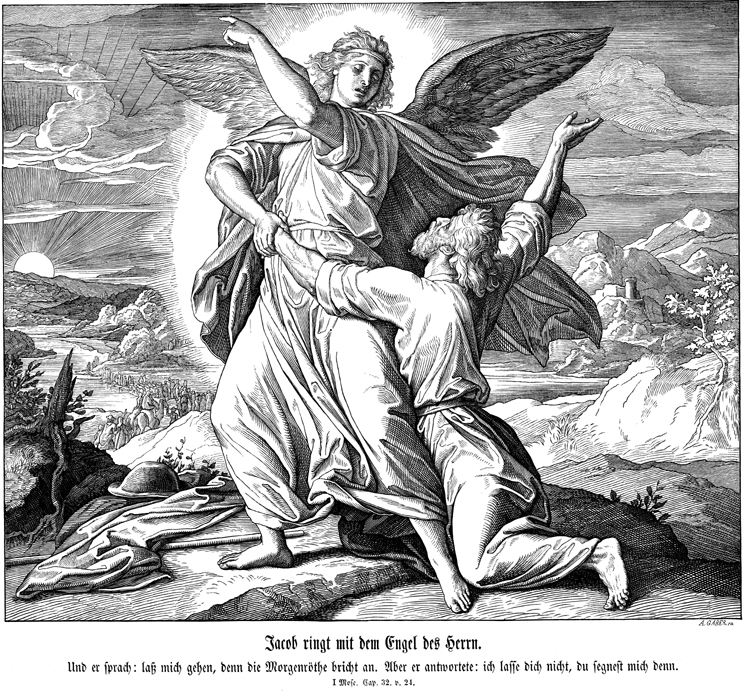
http://www.pitts.emory.edu/dia/detail.cfm?ID=11766
Taken from the New JPS translation, Genesis Chapter 32 says:
23 That same night he arose, and taking his two wives, his two maidservants, and his eleven children, he crossed the ford of the Jabbok. 24 After taking them across the stream, he sent across all his possessions.
וַיִּוָּתֵר יַעֲקֹב, לְבַדּוֹ; וַיֵּאָבֵק אִישׁ עִמּוֹ, עַד עֲלוֹת הַשָּׁחַר.
25 Jacob was left alone. And a man wrestled with him until the break of dawn. 26 When he saw that he had not prevailed against him, he wrenched Jacob's hip at its socket, so that the socket of his hip was strained as he wrestled with him. 27 Then he said, "Let me go, for dawn is breaking." But he answered, "I will not let you go, unless you bless me." 28 Said the other, "What is your name?" He replied, "Jacob."
וַיֹּאמֶר, לֹא יַעֲקֹב יֵאָמֵר עוֹד שִׁמְךָ--כִּי, אִם-יִשְׂרָאֵל: כִּי-שָׂרִיתָ עִם-אֱ-לֹהִים וְעִם-אֲנָשִׁים, וַתּוּכָל.
29 Said he, "Your name shall no longer be Jacob, but Israel, for you have striven with beings divine and human, and have prevailed." 30 Jacob asked, "Pray tell me your name." But he said, "You must not ask my name!" And he took leave of him there. 31 So Jacob named the place Peniel, meaning, "I have seen a divine being face to face, yet my life has been preserved." 32 The sun rose upon him as he passed Penuel, limping on his hip. 33 That is why the children of Israel to this day do not eat the thigh muscle that is on the socket of the hip, since Jacob's hip socket was wrenched at the thigh muscle.
Depending on our thought processes we might read this story in different ways. We might wonder with whom Jacob wrestles, why he wrestles and the significance of where he wrestles.
From a kashrut perspective, we might say this is here to teach us a reason for why we don’t normally get to eat filet mignon. since few kosher producers in this country bother with the expensive deveining process, preferring instead to sell the back of the cow to non-kosher producers!
From a literary perspective, we might notice that Shakespeare has dream sequences before major fight scenes, for example in Richard III and Macbeth.# (Thanks Everett Fox for that idea from his notes in his translation: The Five Books of Moses: Genesis, Exodus, Leviticus, Numbers, Deuteronomy (The Schocken Bible, Volume 1) http://www.amazon.com/Five-Books-Moses-Leviticus-Deuteronomy/dp/0805211195)
From a feminist perspective, we might wonder why Jacob had to separate himself from his spouses to discover himself.
Thinking about this wrestling fight, which didn’t make it on pay-per-view, I found the commentary of a colleague of mine, Rabbi Michael Samuel, a Conservative rabbi outside of San Diego. He described various rabbinic perspectives. The Midrash sees the assailant as Esau’s guardian angel. Elsewhere it was seen as the archetypal battle between good and evil. Hellenistic Jews saw this as Jacob wrestling with himself, perhaps even in a dream. They felt that if he could conquer the enemy within, he could then conquer the enemy without. Rabbi Michael concluded with a quote from Sun Tzu’s Art of War:
Sun Tzu (6th–5th century BCE.) may have expressed this idea best in his Art of War, (ch. 3, Axiom:):
“If you know the enemy and know yourself, you need not fear the result of a hundred battles. If you know yourself but not the enemy, for every victory gained you will also suffer a defeat. If you know neither the enemy nor yourself, you will succumb in every battle.”# http://rabbimichaelsamuel.com/insight/jacob-wrestles-with-the-angel/
This week I have struggled with the ability to see. On Monday, I had LASIK surgery, which has gotten my vision to be just about 20/20. Suddenly my world has changed. After wearing glasses for twenty years, I now have peripheral vision. I can see the clock when I wake up in the middle of the night. I can read at night and hold the book/Kindle/Talmud at any angle, without fear that I’m looking above or below my glasses. When I daven from the shtender here, I can see the Siddur from whatever angle I look! Of course it is not without drawbacks, I will have halos at night for a few weeks, and I am using more eye drops than I knew existed, but it is a powerful experience to be able to see with my eyes “au naturale.” I have been thinking about my vision and Jacob’s vision. While I have not seen an angel or Divine being with my new vision, I have seen the world differently. This is not just because I finally took off my yellowing transitions lenses, the world is a brighter, more colorful place! Rather it is a re-awareness of the miracle, the gift of sight.
Jacob’s gift, after he wrestled with the angel, was a new name: Yisrael, the one who wrestles with Gd. While I love being a Jew, being a descendent of Jehuda, who last week I mentioned has a linguistic connection to thankfulness and gratitude, I am a born Gd-wrestler. The intersection of faith and doubt defines my life, defines my work, defines my vision. I love being a descendent of Yisrael.
With Abraham the name change was static and singular. Avram became Avraham and never looked back. Jacob is different. In the rest of the Torah his name waffles back and forth. Sometimes he is called Jacob, sometimes Israel. Just like the tshuva process, the redemptive process, for many of us, we continue to struggle with our pasts as we work toward the future. I think of those that struggle with anything, whether it is as serious as addiction or as small as money or weight. For every two steps forward, there is the occasional step back or in more difficult times, vice versa.
In this way, Jacob/Yisrael, is far more of a role model for the modern human being. In this parsha we see him struggling to leave his deceitful past behind, but it comes out in the behavior of his sons after the seduction or rape of Dinah. Even as he changed his behavior, the aftereffects are seen in his descendents. Whether genetic or environmental, our behavior has an impact on those around us, our families, our children. This is something I am becoming more cognizant of now, since while I do not know what my daughter notices, I’m sure she sees more than I imagine!
I will conclude this morning with a mention of the other Israel in our minds, the State. The last few weeks have been tough for lovers of Israel, what with hatred all around, even in our own paper, even from Jews! The Israel of our parsha found a path to reconciliation with his brother, with the one whom he had antagonized! If Jacob and Esau can find a way to get along, I pray that we live to see the day when Arabs and Jews can get along. As I wrote in my letter to the paper (which we shall see if it gets printed), Jews, Christians and Muslims have far more in common that we have not in common. If only, peace would be taught rather than war. We can repeat Golda Meir, that peace will come when Arabs love their children more than they hate the Jews, but somehow we will also have to find ways to work with those that hate us. As Abba Eban said, "If you want to make peace, you don't talk to your friends. You talk to your enemies.” May we see the day when war and bloodshed cease, when a great peace will embrace the whole world.
Friday, November 9, 2012
Not in my community!
Rabbi Philip Weintraub
Congregation Agudas Israel
Parshat Haya Sarah
November 10, 2012
Congregation Agudas Israel
Parshat Haya Sarah
November 10, 2012
Life changes in a moment. We expect one thing and discover another. For many across our area, who struggled through Hurricane Sandy, a Nor’easter came through the other day, complicating power outages, extending time without normal resources. In NYC, Long Island, and New Jersey, gas is being rationed as stations struggle to fill-up with refinery production down and consistent power still difficult. Our neighbor, Rabbi Freedman, was called up by the Reserves and is packing boxes of food and supplies in NYC, possibly as we speak!
This morning I had originally planned to speak about the parsha, Haya Sarah and the irony (or not) of a parsha entitled the “life of Sarah” opening with her death and closing with the death of Abraham. I might have discussed that the parsha was appropriately titled, since the majority of the parsha is about Sarah’s legacy, about her son Isaac and the arrangement of his marriage to Rebecca. I might have made connections to the joy I have with my own Rebecca and how we are a testament to the values of our ancestors when we live our lives according to those values. On that note, I might have discussed the loss of Sylvia Golub and how her family was trying to live out her Jewish values. Since there are so many serious matters in Genesis, I wanted to talk about the joys of relationship, of connecting to the Divine and the community. I might even have discussed that today/yesterday is the anniversary of Kristallnacht, the night of the broken glass, which was a precursor to the Nazi atrocities.
One of these days I will give a sermon that follows the “rules” and structure of sermons, but today is not one of those days. Instead I want to mention a very important subject. On Thursday I was at a meeting of the Greater Newburgh Ministerial Association. Before I get to the important subject that I have yet to mention, I want to invite you to the Newburgh Interfaith Thanksgiving Service. It is 7PM at the Ebeneezer Baptist Church, Tuesday November 20.
The important subject of the GNMA meeting was domestic violence. We had a speaker from Safe Homes of Orange County. Their focus is on helping individuals in abusive relationships escape the clutches of their partners. While it is not exclusively to protect women from abusive men, that is the majority of their clientele. At the same time, people can be abused from either gender, in same-sex relationships and unfortunately children can also be abused by their parents. In conversation with the clergy, she discussed how faith can be both a support and a barrier for individuals to escape damaging relationships. Many religious people (especially Christians) believe that religion does not accept divorce. In the Jewish tradition, while divorce is halachically acceptable, we place a premium on Shalom Bayit, on peace in the home, and so many people choose to remain in abusive relationships so as not to break that bond.
From the safe homes website:
Domestic violence is a pattern of coercive behavior used to maintain power and control over an intimate partner.
Domestic violence has its roots in sexism and the historical oppression of women.
Intimate-partner violence occurs in families of all social, racial, economic, educational and religious backgrounds. It is present in towns, suburbs, rural areas and neighborhoods. While women with fewer economic resources may seek help more often or report domestic violence more frequently, it doesn’t mean that women in the upper and middle classes are less likely to be victimized. Economic advantages can improve a woman's options and resources and facilitate access to readily-available private services--resulting in underreported violence.
Myths and Misperception Versus Reality (also from SafeHOMES)
--Myth: Alcohol and drug abuse cause intimate-partner violence.
Reality: Alcohol and drug abuse do not cause intimate-partner violence. In the presence of alcohol and drug abuse, violence may increase or become more severe, and existent violent behavior may intensify.
Sixty-five percent of intimate-partner violence cases DO NOT involve drugs or alcohol. Many batterers do not abuse alcohol or drugs, and many alcohol or drug abusers do not batter. Chemical dependency treatment will not cure battering; the two problems need to be addressed separately. The alcohol abuse rate for abused women is similar to that of the general female population, 7 to 14 percent. Moreover, a woman's alcohol abuse does not justify being battered.
--Myth: Battered women are masochistic and crazy; they provoke and enjoy their abuse.
Reality: Women do not provoke or deserve battering. They deserve a violence-free life. As it happens with rape, an attempt is made to blame the victim for the behavior of the attacker. Abusers commonly blame their battering on alcohol and drug abuse, minor frustrations, and/or the words or behavior of their partner. However, the abuser's use of violence is the abuser's choice. There are non-violent ways to deal with anger.
A battered woman's reactions to the violence are normal, given the circumstances, and the reactions are often necessary for survival. She is not crazy. She still hopes her partner will change, and indeed, he may show remorse and good times may follow. However, over time, remorse and good times will decrease, while the abuse and violence escalate.
--Myth: Men who abuse women are mentally ill and not responsible for their actions.
Reality: Battering is a learned behavior from childhood experiences and from social messages condoning violence against women. Psychological tests have repeatedly shown that men who abuse women do not differ from the "normal" male. Lenore Walker's study* showed that batterers had learned as children that violence was an appropriate response to anger. Abusers are not out of control; they are attempting to gain control over their partner through demands, threats, and physical abuse. They deny and minimize the violence; they blame their partners for the violence. The violent behaviors of abusers will continue as long as society refuses to treat intimate-partner violence as a serious crime and impose serious consequences.
Are You In An Abusive Relationship?
Domestic violence can take many different forms. It involves physical, emotional, mental, economical, and sexual abuse. At first, the control and manipulation a partner uses can be very subtle. The abuse can and will escalate over time. Answer "yes" or "no" to the following questions:- Does your partner continually criticize what you wear, what you say, how you act and how you look?
- Does your partner humiliate or make fun of you in public places and social situations?
- Does your partner often call you insulting and degrading names?
- Do you feel like you need to ask permission to go out and see your friends and family?
- Do you turn down invitations to be with your friends and family because your partner will be angry at you for joining them?
- Do you feel you need to apologize to people or make up excuses for your partner's behavior?
- Do you feel like no matter what you do, everything is always your fault?
- If you're late getting home, does your partner harass you about where you were and who you were with?
- Has your partner threatened to hurt you or the children if you leave?
- Does your partner force you to have sex whether you want to or not?
- Are you afraid to say no to sex?
- Have you been repeatedly accused of flirting or having sex with others?
- Does your partner restrict you from getting a job or going to school?
- Has your partner hit you or threatened to hit you?
- Has your partner ever pushed, shoved, kicked or slapped you?
- Do you ever explain away bruises, cuts, or other injuries as results of how "clumsy" you are?
- Do you feel nervous or afraid for your safety when your partner becomes angry?
- Are you afraid to disagree with your partner?
- Are you frightened by your partner's violence towards other people or animals?
- Do you change your behavior or "walk on eggshells," depending on your partner's mood?
- Do you ever think "If only I was prettier", or "If only I cleaned the house better", or "If only I had kept the children quieter", etc., "then my partner wouldn't have been angry?"
Jewish resources include:
JWI is the leading Jewish organization empowering women and girls - through economic literacy; community training; healthy relationship education; and the proliferation of women’s leadership.
Is there really abuse in the Jewish community?
Abuse does not favor one religious, economic, religious, or ethnic group over another. It is found in all groups—including the Jewish community. It also does not favor more conservative or more liberal groups—it is found across the spectrum of Jewish affiliations (and lack of affiliation). We do not have good numbers as to the incidence of abuse in the Jewish community; many Jews and Jewish groups are uncooperative in identifying the problem. Many involved in the field suggest that the incidence of abuse is on par with that of other communities.
Am I the only Jewish woman who has ever been abused?
Because of the long history of stereotypes—Jewish men make the best husbands (truth is, many of them do, although the Jewish community does not have a monopoly on this market!) and that Jewish marriages are loving, supportive and solid—it has been difficult for Jewish women to identify themselves as being abused, difficult to get the help that they need, and difficult to make hard decisions about their futures.
What does Judaism have to say about abuse?
Jewish tradition is very clear: it is forbidden for one person to harm another. This includes physical abuse: the Talmud states that it is forbidden to even raise a hand against another; sexual abuse: Jewish law recognized the unacceptability of marital rape more than 2,000 years ago; emotional abuse: Jewish law prohibits humiliating or belittling another person through word and deed; and economic abuse: the Talmud states that a husband must generously provide for his family (in today’s society this responsibility is often shared by both partners).
Isn’t it lashon ha-ra (slander) to speak out against an abuser?
“Lashon ha-ra” is the Hebrew phrase for derogatory speech which includes libel and slander. The Torah states (Lev. 19:16): “You shall not walk around as a talebearer against your people; do not stand on the blood of your neighbor.” This verse is interpreted to mean that speaking lashon ha-ra is tantamount to murdering them (in fact you can easily kill someone’s reputation this way). It is often assumed that speaking critically about an abuser would be restricted by this verse. Nothing could be further than the truth! In fact, just as speech can be a killer—so too can silence. If remaining silent will bring harm there is an obligation to speak out against a perpetrator, even if his reputation will be damaged.
Must I forgive my abuser?
Forgiveness is dependent upon “Teshuvah” (repentance) and must be earned. Until a perpetrator is sincerely contrite, makes up for all of the harm—both physical and emotional—that he caused, earnestly asks for forgiveness, and never repeats the harms committed, forgiveness is not required. These steps are difficult and take a long time. For many they are impossible. Although forgiveness may not be required, it is left to each individual to determine what is in her best interest as far as her own healing and her ability to move on into the future are concerned.
I wanted to share this with you not to accuse anyone of this behavior, but so that our community knows that this conversation is acceptable here. We must make a statement that abuse, in any form, is unacceptable. We must make it clear that our shul, our home is and should always be a safe space, a place free of danger from others, no matter how close they are to home!
Shabbat Shalom
Subscribe to:
Posts (Atom)