Around the web this week have been discussions of Bar Mitzvah videos.
See this link for an example:
http://www.tabletmag.com/scroll/140726/the-evolution-of-the-bar-mitzvah-dance-video
Many looking at this video see it as over the top. They complain of the money wasted on it, the seemingly outrageous idea of hiring professional dancers in skimpy outfit, and the lack of Jewish content. I guess they didn't see the pre-Bar Mitzvah video--the second video on the page. That one included friends and family, kippot, studying? his parsha, and perhaps his rabbi (or at least some shots in the shul--with the family's name on the donation wall).
As we enter Elul, it is appropriate for us to consider the words that come out of our mouths, the thoughts we choose to share with others in line, online, or anywhere. Whether we speak, type, sign or otherwise communicate, what we share with others is a reflection of our values. If we choose to berate 13 year olds and their values publicly, what does that say about us?
There is a classic story of an individual who comes to the rabbi after sharing a rumor about someone. The rabbi says the person should empty a feather pillow on top of a mountain on a windy day and then come back to the rabbi's office the following day. The next day the individual returns and the rabbis says go back to the mountain and collect all of the feathers. The individual says that is impossible! They have been dispersed throughout the village. The rabbi says--yes that is the danger of speaking. Our words can spread farther than we ever imagined.
Today that is more true than ever. One blog can be shared and re-shared, tweeted and retweeted until it goes as viral as the video above. Rather than seeing the internet as a way to write more and more nonsense, we must see it as a place to spread more and more holiness, kindness and love.
Yet if we do NOT speak, what does that say about us? As Jews we are commanded not to stand idly by. We are supposed to warn/stop/prevent evil or bad behavior by our friends and compatriots. Yet, to give effective warnings and criticisms, we must know the individual and care for them.
Is this video over the top? Of course it is. Does it reflect what I hope for my daughter's Bat Mitzvah? No, it does not. I would much rather see a video of this young man's charitable works, how he volunteers his free time, how he uses his (clearly) tremendous financial resources to do good, and finally, how he studies and lives Torah.
At the end of the day though, he is a kid and none of this happened entirely through his own will or resources. His parents participated and funded it. Most importantly, they felt that his Jewish identity was important enough to celebrate his becoming a Bar Mitzvah. While it may be over the top, he and his family are clearly members of a Jewish community and supporters of a congregation (see their name on the wall in the second video). That in itself is a great mitzvah.
How do you celebrate your Jewish identity?
Do you make a viral video?
Do you speak kindly or rudely to the efforts of others?
As we approach Rosh Hashanah, let us consider not only how we speak, but to whom we speak, where we speak and what the next person will say. The Chafetz Chaim, the master teacher on the laws of speech tells us we should not even speak positively about someone in the presence of that person's enemy, since we will be facilitating lashon hara! (Ie no "Bush is the best president ever" at the DNC convention or "Obama is awesome" at a Tea Party event.)
Showing posts with label 5773. Show all posts
Showing posts with label 5773. Show all posts
Friday, August 9, 2013

Friday, November 2, 2012
Parshat Vayera and a Hurricane
Rabbi Philip Weintraub
November 3, 2012/5773
Parshat Vayera
Before I say anything else this morning, I would like us to take a moment of silence to remember the losses of Frankenstorm Sandy, the men, women, and children who lost their lives by fire, by water, by land and by sea. We pray that their families will find solace in their communities, comfort in the arms of loved ones and with the embrace of the Divine.
[Pause]
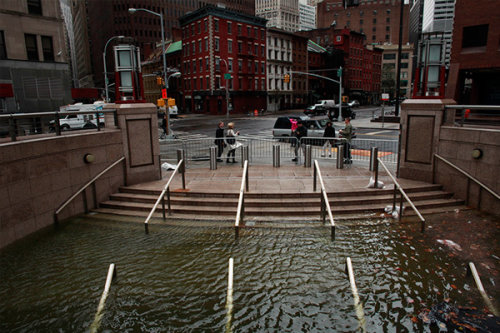 |
| Flooding from Sandy in NYC http://finance.yahoo.com/news/scenes-from-hurricane-sandy.html |
While not Parshat Noah, this week’s parsha is very appropriate for the events of the last week. It is a big parsha, which includes many familiar biblical stories--Abraham’s hospitality for the angels, Abraham negotiating with Gd regarding Sodom and Gemorrah, Abraham again pretending Sarah is his sister with Avimelech, Sarah and Abraham sending away Hagar and Ishmael and ending with the Akedah. Those last two narratives should be relatively familiar, since we read them on Rosh Hashanah. Even if Vayera does not include floods, it does include wacky weather, with the fire and brimstone that annihilate Sodom and Gemorrah!
This issues in this parsha are particularly relevant to us today. While out of order, when bad things happen, we frequently try to negotiate with Gd. If only Gd will do xyz, we will be better at xyz. We say we will behave better, pray more, go to shul more, eat more carefully, etc. etc. And frequently, like New Year’s Resolutions, the tshuvah, our process of repenting and rethinking, that we began on Rosh Hashanah is wearing off now, a few weeks later.
When bad things happen, we sometimes react poorly, as Sarah and Abraham might have done sending away their rebellious son, Ishmael (unless they were acting exactly properly in keeping their dangerous son from hurting their innocent son--but more on that another year). We sometimes add insult to injury by making things worse--like rushing to the gas station because of supposed gas shortages, which of course, encourage a gas shortage!
Yet when terrible things happen, we also see the best in others. In area without power, people have gathered for street-wide barbeques, sharing generators, power outlets, and phones (when they work). People have offered their homes to relatives and friends, even strangers. Emulating Abraham, they welcomed others in, even as they were not sure how they were doing themselves. Our parsha opens with Abraham recovering from his circumcision, yet when he sees guests, he does not stay in bed, but runs to them, offers to wash the desert grime off their feet, and prepares them a hot meal. From Abraham, we learn the mitzvah of Hachnasat Orchim, welcoming guests. While I do not think of them as guests, I am happy to have Rebecca’s parents with us, as their home in Long Beach is not habitable, at present.
While this is not a sermon on philosophy, this week’s parsha offers us many ideas about our relationship with Gd. In this parsha, Gd is demanding of us. Gd asks us to sacrifice of ourselves, perhaps even of our children, to uphold our covenant. Gd says that to be a human being, to be a Jew, is not simply to dwell on this planet, but to be responsible. We must care for our families, for our communities, and even for our environment. Gd says this world, this life is a gift, but it comes at a price. Life is not free and can change at any moment. Yet, we must be eager to help others, to follow Gd’s commands. In Parshat Vayera, Abraham does not walk anywhere. He runs to do mitzvot. He runs to help the angels. He gets up early in the morning to take Isaac to the altar.
In a further confluence of events, October 26, was Id al-Adha, the festival of sacrifice, when Muslims remember that the son of Abraham was almost sacrificed. While today most Muslims see that sacrifice as Ishmael, rather than as Jews and Christians do of Isaac, many medieval Muslim commentators agreed with the Jewish and Christian interpretation. Rabbi Professor/Doctor Moshe Sokolow of Yeshiva University wrote a fascinating article on that subject last week for the Jewish Ideas Daily website. [http://www.jewishideasdaily.com/5234/features/whose-akedah-was-it-anyhow/] He notes that Muslims read the Akedah/sacrifice narrative in much the same way Jews do, to demonstrate their particular covenant with Gd. Amazingly, in defining our differences, we see our similarities!
Returning to our Haftorah, we read the prophetic stories of Elisha from Second Kings, chapter 4. These miracles, which I retold on Rosh Hashanah Eve, in the story “Just a Miracle” are a reminder that our everyday lives our miraculous. (Using the author of that story, I misquoted the prophet though, it wasn’t Elijah, but Elisha, his disciple. The Elijah stories are in first Kings!) Every breath we take is a miracle. Every birth (which I am now more aware of) is a miracle. Every advance in medical technology is a miracle. For example, C-sections are called C-sections because of Ceasar, and have been around for thousands of years, until recent centuries, the mother rarely survived. Modern surgery and anesthetic techniques are truly miraculous when we think about them. After a few hours or days without electricity, we realize the miracles there, too!
I want to return this morning’s conversation to the start of my drash. At times I have spoken about the power of prayer. I have noted that Individuals pray for different reasons, whether physical, mental, emotional, or spiritual. Some pray expecting Gd to act literally according to their wishes, while others pray for the strength and ability to personally fulfill their hopes. However we pray, we can find comfort by praying in community. As Jews, even when we pray alone, we try to pray with community. Thus, if we cannot pray in a minyan, we try to pray at the same time as a minyan, or in the same space at an alternate time.
Recently, the Jewish Theological Seminary began a weekly conversation on prayer on their website. Rabbi Barth, a professor of liturgy, shared the words of Rabbi Ferdinand Isserman: "Prayer invites God's presence to suffuse our spirits; God's will to prevail in our lives. Prayer might not bring water to parched fields, nor mend a broken bridge, nor rebuild a ruined city. But prayer can water an arid soul, mend a broken heart, rebuild a weakened will." [http://www.jtsa.edu/Conservative_Judaism/JTS_Torah_Commentary/Avodat_Va-yera.xml
More info on Rabbi Isserman, who served in Toronto and St Louis http://www.findagrave.com/cgi-bin/fg.cgi?page=gr&GRid=37333825]
Our tradition discourages us from prayer in vain, from praying to change events that have already occurred. Thus, we could originally pray that Sandy go out to sea, but once it was here, we could not pray that the laws of nature be forgotten! In the words of Rabbi Barth, we could pray “that our hearts remain open, and that our souls find connection with Gd.” He continues “We do not pray to change the physical world, we do not pray for miraculous deliverance. We pray that we ourselves be strengthened and transformed—so that we, ourselves, will indeed transform the world.”
On that note I want to conclude with a prayer by another rabbinic colleague, Rabbi Menachem Creditor, currently of Berkeley, CA.
A Prayer in the Aftermath of a Devastating Storm
© Rabbi Menachem Creditor
in recognition of the holy work of the American Red Cross
Elohei haRuchot, God of the Winds,[1]
Fixated as we are by incalculable losses in our families, our neighbors, human beings spanning national borders, we are pummeled into shock, barely even able to call out to You.
We are, as ever, called to share bread with the hungry, to take those who suffer into our homes, to clothe the naked, to not ignore our sisters and brothers.[2] Many more of our brothers and sisters are hungry, homeless, cold, and vulnerable today than were just a few days ago, and we need Your Help.
We pray from the depths of our souls and we pray with the toil of our bodies for healing in the face of devastation. We join our voices in prayer to the prayers of others around the world and cry out for safety. We look to the sacred wells of human resilience and compassion and ask You for even more strength and hope.
God, open our hearts to generously support those determined to undo this chaos.
God, be with us as we utilize every network at our disposal to support each other. Be with First Responders engaged in the work of rescue as they cradle lives new and old, sheltering our souls and bodies from the storm. Be with us and be with them, God.
Be with those awaiting news from loved ones, reeling from fire, water and wind that have crippled cities, decimated villages, and taken lives. Be with all of us, God.
Be with us God, comfort us, and support us as we rebuild that which has been lost.
May all this be Your will.
Amen.
[1] Numbers 27:16
[2] adapted from Isaiah 58:6-7
Subscribe to:
Posts (Atom)