Friday, November 30, 2012

Visions and WWF


Rabbi Philip Weintraub
Parshat Vayishlach
December 1, 2012

Our parsha this week opens with Jacob and Esau at the brink of war or reconciliation.  Jacob is so nervous about what is to come that he divides his camp, ensuring that if Esau slaughters some of his family, at least he will have one wife and some children left.  [Speaking with Roz yesterday, she reminded me that some parents never travel on the same plane, for fear of leaving their children orphaned. Not sure that makes much sense to me, but I try not to judge other people’s parenting with only a few weeks experience to my name.]  At the brink of war or peace, Jacob goes to sleep.
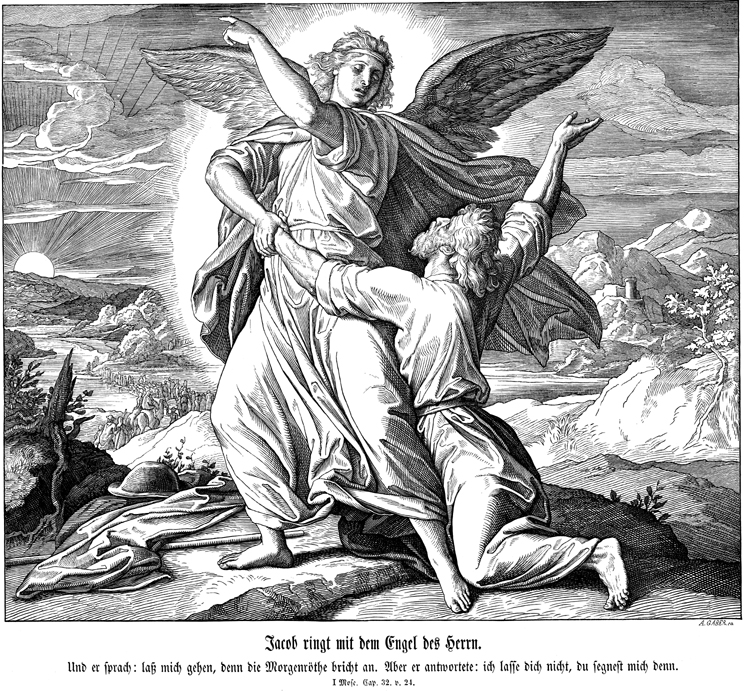
http://www.pitts.emory.edu/dia/detail.cfm?ID=11766


Taken from the New JPS translation, Genesis Chapter  32 says:

23 That same night he arose, and taking his two wives, his two maidservants, and his eleven children, he crossed the ford of the Jabbok. 24 After taking them across the stream, he sent across all his possessions.
וַיִּוָּתֵר יַעֲקֹב, לְבַדּוֹ; וַיֵּאָבֵק אִישׁ עִמּוֹ, עַד עֲלוֹת הַשָּׁחַר.
25 Jacob was left alone. And a man wrestled with him until the break of dawn. 26 When he saw that he had not prevailed against him, he wrenched Jacob's hip at its socket, so that the socket of his hip was strained as he wrestled with him. 27 Then he said, "Let me go, for dawn is breaking." But he answered, "I will not let you go, unless you bless me." 28 Said the other, "What is your name?" He replied, "Jacob."
וַיֹּאמֶר, לֹא יַעֲקֹב יֵאָמֵר עוֹד שִׁמְךָ--כִּי, אִם-יִשְׂרָאֵל:  כִּי-שָׂרִיתָ עִם-אֱ-לֹהִים וְעִם-אֲנָשִׁים, וַתּוּכָל.
29 Said he, "Your name shall no longer be Jacob, but Israel, for you have striven with beings divine and human, and have prevailed." 30 Jacob asked, "Pray tell me your name." But he said, "You must not ask my name!" And he took leave of him there. 31 So Jacob named the place Peniel, meaning, "I have seen a divine being face to face, yet my life has been preserved." 32 The sun rose upon him as he passed Penuel, limping on his hip. 33 That is why the children of Israel to this day do not eat the thigh muscle that is on the socket of the hip, since Jacob's hip socket was wrenched at the thigh muscle.

Depending on our thought processes we might read this story in different ways.  We might wonder with whom Jacob wrestles, why he wrestles and the significance of where he wrestles.

From a kashrut perspective, we might say this is here to teach us a reason for why we don’t normally get to eat filet mignon. since few kosher producers in this country bother with the expensive deveining process, preferring instead to sell the back of the cow to non-kosher producers!

From a literary perspective, we might notice that Shakespeare has dream sequences before major fight scenes, for example in Richard III and Macbeth.# (Thanks Everett Fox for that idea from his notes in his translation: The Five Books of Moses: Genesis, Exodus, Leviticus, Numbers, Deuteronomy (The Schocken Bible, Volume 1) http://www.amazon.com/Five-Books-Moses-Leviticus-Deuteronomy/dp/0805211195)

From a feminist perspective, we might wonder why Jacob had to separate himself from his spouses to discover himself.

Thinking about this wrestling fight, which didn’t make it on pay-per-view, I found the commentary of a colleague of mine, Rabbi Michael Samuel, a Conservative rabbi outside of San Diego.  He described various rabbinic perspectives. The Midrash sees the assailant as Esau’s guardian angel.  Elsewhere it was seen as the archetypal battle between good and evil.  Hellenistic Jews saw this as Jacob wrestling with himself, perhaps even in a dream.  They felt that if he could conquer the enemy within, he could then conquer the enemy without.  Rabbi Michael concluded with a quote from Sun Tzu’s Art of War:
Sun Tzu (6th–5th century BCE.) may have expressed this idea best in his Art of War, (ch. 3, Axiom:):
“If you know the enemy and know yourself, you need not fear the result of a hundred battles. If you know yourself but not the enemy, for every victory gained you will also suffer a defeat. If you know neither the enemy nor yourself, you will succumb in every battle.”# http://rabbimichaelsamuel.com/insight/jacob-wrestles-with-the-angel/

This week I have struggled with the ability to see.  On Monday, I had LASIK surgery, which has gotten my vision to be just about 20/20.  Suddenly my world has changed.  After wearing glasses for twenty years, I now have peripheral vision.  I can see the clock when I wake up in the middle of the night.  I can read at night and hold the book/Kindle/Talmud at any angle, without fear that I’m looking above or below my glasses.  When I daven from the shtender here, I can see the Siddur from whatever angle I look!  Of course it is not without drawbacks, I will have halos at night for a few weeks, and I am using more eye drops than I knew existed, but it is a powerful experience to be able to see with my eyes “au naturale.”  I have been thinking about my vision and Jacob’s vision.  While I have not seen an angel or Divine being with my new vision, I have seen the world differently.  This is not just because I finally took off my yellowing transitions lenses, the world is a brighter, more colorful place!  Rather it is a re-awareness of the miracle, the gift of sight.

Jacob’s gift, after he wrestled with the angel, was a new name: Yisrael, the one who wrestles with Gd.  While I love being a Jew, being a descendent of Jehuda, who last week I mentioned has a linguistic connection to thankfulness and gratitude, I am a born Gd-wrestler.  The intersection of faith and doubt defines my life, defines my work, defines my vision.  I love being a descendent of Yisrael.  

With Abraham the name change was static and singular.  Avram became Avraham and never looked back.  Jacob is different.  In the rest of the Torah his name waffles back and forth.  Sometimes he is called Jacob, sometimes Israel.  Just like the tshuva process, the redemptive process, for many of us, we continue to struggle with our pasts as we work toward the future.  I think of those that struggle with anything, whether it is as serious as addiction or as small as money or weight.  For every two steps forward, there is the occasional step back or in more difficult times, vice versa.  

In this way, Jacob/Yisrael, is far more of a role model for the modern human being.  In this parsha we see him struggling to leave his deceitful past behind, but it comes out in the behavior of his sons after the seduction or rape of Dinah.  Even as he changed his behavior, the aftereffects are seen in his descendents.  Whether genetic or environmental, our behavior has an impact on those around us, our families, our children.  This is something I am becoming more cognizant of now, since while I do not know what my daughter notices, I’m sure she sees more than I imagine!

I will conclude this morning with a mention of the other Israel in our minds, the State.  The last few weeks have been tough for lovers of Israel, what with hatred all around, even in our own paper, even from Jews!  The Israel of our parsha found a path to reconciliation with his brother, with the one whom he had antagonized!  If Jacob and Esau can find a way to get along, I pray that we live to see the day when Arabs and Jews can get along.  As I wrote in my letter to the paper (which we shall see if it gets printed), Jews, Christians and Muslims have far more in common that we have not in common.  If only, peace would be taught rather than war.  We can repeat Golda Meir, that peace will come when Arabs love their children more than they hate the Jews, but somehow we will also have to find ways to work with those that hate us.  As Abba Eban said, "If you want to make peace, you don't talk to your friends. You talk to your enemies.”  May we see the day when war and bloodshed cease, when a great peace will embrace the whole world.


Friday, November 9, 2012

Not in my community!

Rabbi Philip Weintraub
Congregation Agudas Israel
Parshat Haya Sarah
November 10, 2012

Life changes in a moment.  We expect one thing and discover another.  For many across our area, who struggled through Hurricane Sandy, a Nor’easter came through the other day, complicating power outages, extending time without normal resources.  In NYC, Long Island, and New Jersey, gas is being rationed as stations struggle to fill-up with refinery production down and consistent power still difficult.  Our neighbor, Rabbi Freedman, was called up by the Reserves and is packing boxes of food and supplies in NYC, possibly as we speak!

This morning I had originally planned to speak about the parsha, Haya Sarah and the irony (or not) of a parsha entitled the “life of Sarah” opening with her death and closing with the death of Abraham.  I might have discussed that the parsha was appropriately titled, since the majority of the parsha is about Sarah’s legacy, about her son Isaac and the arrangement of his marriage to Rebecca.  I might have made connections to the joy I have with my own Rebecca and how we are a testament to the values of our ancestors when we live our lives according to those values.  On that note, I might have discussed the loss of Sylvia Golub and how her family was trying to live out her Jewish values.  Since there are so many serious matters in Genesis, I wanted to talk about the joys of relationship, of connecting to the Divine and the community.  I might even have discussed that today/yesterday is the anniversary of Kristallnacht, the night of the broken glass, which was a precursor to the Nazi atrocities.

One of these days I will give a sermon that follows the “rules” and structure of sermons, but today is not one of those days.  Instead I want to mention a very important subject.  On Thursday I was at a meeting of the Greater Newburgh Ministerial Association.  Before I get to the important subject that I have yet to mention, I want to invite you to the Newburgh Interfaith Thanksgiving Service.  It is 7PM at the Ebeneezer Baptist Church, Tuesday November 20.

The important subject of the GNMA meeting was domestic violence.  We had a speaker from Safe Homes of Orange County.  Their focus is on helping individuals in abusive relationships escape the clutches of their partners.  While it is not exclusively to protect women from abusive men, that is the majority of their clientele.  At the same time, people can be abused from either gender, in same-sex relationships and unfortunately children can also be abused by their parents.  In conversation with the clergy, she discussed how faith can be both a support and a barrier for individuals to escape damaging relationships.  Many religious people (especially Christians) believe that religion does not accept divorce.  In the Jewish tradition, while divorce is halachically acceptable, we place a premium on Shalom Bayit, on peace in the home, and so many people choose to remain in abusive relationships so as not to break that bond.

From the safe homes website:
Domestic violence is a pattern of coercive behavior used to maintain power and control over an intimate partner.
Domestic violence has its roots in sexism and the historical oppression of women.
Intimate-partner violence occurs in families of all social, racial, economic, educational and religious backgrounds.  It is present in towns, suburbs, rural areas and neighborhoods.  While women with fewer economic resources may seek help more often or report domestic violence more frequently, it doesn’t mean that women in the upper and middle classes are less likely to be victimized.  Economic advantages can improve a woman's options and resources and facilitate access to readily-available private services--resulting in underreported violence.

Myths and Misperception Versus Reality (also from SafeHOMES)
--Myth: Alcohol and drug abuse cause intimate-partner violence.

Reality: Alcohol and drug abuse do not cause intimate-partner violence.  In the presence of alcohol and drug abuse, violence may increase or become more severe, and existent violent behavior may intensify.
Sixty-five percent of intimate-partner violence cases DO NOT involve drugs or alcohol.  Many batterers do not abuse alcohol or drugs, and many alcohol or drug abusers do not batter.  Chemical dependency treatment will not cure battering; the two problems need to be addressed separately.  The alcohol abuse rate for abused women is similar to that of the general female population, 7 to 14 percent.  Moreover, a woman's alcohol abuse does not justify being battered.
--Myth: Battered women are masochistic and crazy; they provoke and enjoy their abuse.

Reality: Women do not provoke or deserve battering.  They deserve a violence-free life.  As it happens with rape, an attempt is made to blame the victim for the behavior of the attacker.  Abusers commonly blame their battering on alcohol and drug abuse, minor frustrations, and/or the words or behavior of their partner.  However, the abuser's use of violence is the abuser's choice.  There are non-violent ways to deal with anger.

A battered woman's reactions to the violence are normal, given the circumstances, and the reactions are often necessary for survival.  She is not crazy.  She still hopes her partner will change, and indeed, he may show remorse and good times may follow.  However, over time, remorse and good times will decrease, while the abuse and violence escalate.
--Myth: Men who abuse women are mentally ill and not responsible for their actions.

Reality: Battering is a learned behavior from childhood experiences and from social messages condoning violence against women.  Psychological tests have repeatedly shown that men who abuse women do not differ from the "normal" male.  Lenore Walker's study* showed that batterers had learned as children that violence was an appropriate response to anger.  Abusers are not out of control; they are attempting to gain control over their partner through demands, threats, and physical abuse.  They deny and minimize the violence; they blame their partners for the violence.  The violent behaviors of abusers will continue as long as society refuses to treat intimate-partner violence as a serious crime and impose serious consequences.
Are You In An Abusive Relationship?
Domestic violence can take many different forms.  It involves physical, emotional, mental, economical, and sexual abuse.  At first, the control and manipulation a partner uses can be very subtle.  The abuse can and will escalate over time.  Answer "yes" or "no" to the following questions:

  • Does your partner continually criticize what you wear, what you say, how you act and how you look?
  • Does your partner humiliate or make fun of you in public places and social situations?
  • Does your partner often call you insulting and degrading names?
  • Do you feel like you need to ask permission to go out and see your friends and family?
  • Do you turn down invitations to be with your friends and family because your partner will be angry at you for joining them?
  • Do you feel you need to apologize to people or make up excuses for your partner's behavior?
  • Do you feel like no matter what you do, everything is always your fault?
  • If you're late getting home, does your partner harass you about where you were and who you were with?
  • Has your partner threatened to hurt you or the children if you leave?
  • Does your partner force you to have sex whether you want to or not?
  • Are you afraid to say no to sex?
  • Have you been repeatedly accused of flirting or having sex with others?
  • Does your partner restrict you from getting a job or going to school?
  • Has your partner hit you or threatened to hit you?
  • Has your partner ever pushed, shoved, kicked or slapped you?
  • Do you ever explain away bruises, cuts, or other injuries as results of how "clumsy" you are?
  • Do you feel nervous or afraid for your safety when your partner becomes angry?
  • Are you afraid to disagree with your partner?
  • Are you frightened by your partner's violence towards other people or animals?
  • Do you change your behavior or "walk on eggshells," depending on your partner's mood?
  • Do you ever think "If only I was prettier", or "If only I cleaned the house better", or "If only I had kept the children quieter", etc., "then my partner wouldn't have been angry?"
If you answer "yes" to any of these questions, you may be a victim of abuse.


Jewish resources include:
JWI is the leading Jewish organization empowering women and girls - through economic literacy; community training; healthy relationship education; and the proliferation of women’s leadership.
       
Is there really abuse in the Jewish community?
Abuse does not favor one religious, economic, religious, or ethnic group over another. It is found in all groups—including the Jewish community. It also does not favor more conservative or more liberal groups—it is found across the spectrum of Jewish affiliations (and lack of affiliation). We do not have good numbers as to the incidence of abuse in the Jewish community; many Jews and Jewish groups are uncooperative in identifying the problem. Many involved in the field suggest that the incidence of abuse is on par with that of other communities.

Am I the only Jewish woman who has ever been abused?
Because of the long history of stereotypes—Jewish men make the best husbands (truth is, many of them do, although the Jewish community does not have a monopoly on this market!) and that Jewish marriages are loving, supportive and solid—it has been difficult for Jewish women to identify themselves as being abused, difficult to get the help that they need, and difficult to make hard decisions about their futures.

What does Judaism have to say about abuse?
Jewish tradition is very clear: it is forbidden for one person to harm another. This includes physical abuse: the Talmud states that it is forbidden to even raise a hand against another; sexual abuse: Jewish law recognized the unacceptability of marital rape more than 2,000 years ago; emotional abuse: Jewish law prohibits humiliating or belittling another person through word and deed; and economic abuse: the Talmud states that a husband must generously provide for his family (in today’s society this responsibility is often shared by both partners).

Isn’t it lashon ha-ra (slander) to speak out against an abuser?
“Lashon ha-ra” is the Hebrew phrase for derogatory speech which includes libel and slander. The Torah states (Lev. 19:16): “You shall not walk around as a talebearer against your people; do not stand on the blood of your neighbor.” This verse is interpreted to mean that speaking lashon ha-ra is tantamount to murdering them (in fact you can easily kill someone’s reputation this way). It is often assumed that speaking critically about an abuser would be restricted by this verse. Nothing could be further than the truth! In fact, just as speech can be a killer—so too can silence. If remaining silent will bring harm there is an obligation to speak out against a perpetrator, even if his reputation will be damaged.
Must I forgive my abuser?
Forgiveness is dependent upon “Teshuvah” (repentance) and must be earned. Until a perpetrator is sincerely contrite, makes up for all of the harm—both physical and emotional—that he caused, earnestly asks for forgiveness, and never repeats the harms committed, forgiveness is not required. These steps are difficult and take a long time. For many they are impossible. Although forgiveness may not be required, it is left to each individual to determine what is in her best interest as far as her own healing and her ability to move on into the future are concerned.

I wanted to share this with you not to accuse anyone of this behavior, but so that our community knows that this conversation is acceptable here.  We must make a statement that abuse, in any form, is unacceptable.  We must make it clear that our shul, our home is and should always be a safe space, a place free of danger from others, no matter how close they are to home!
Shabbat Shalom

Friday, November 2, 2012

Parshat Vayera and a Hurricane


Rabbi Philip Weintraub

November 3, 2012/5773
Parshat Vayera


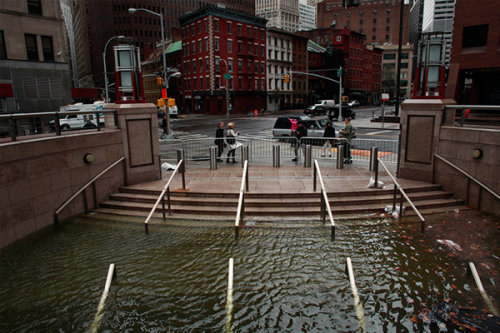
Before I say anything else this morning, I would like us to take a moment of silence to remember the losses of Frankenstorm Sandy, the men, women, and children who lost their lives by fire, by water, by land and by sea.  We pray that their families will find solace in their communities, comfort in the arms of loved ones and with the embrace of the Divine.  

[Pause] 

Flooding from Sandy in NYC
http://finance.yahoo.com/news/scenes-from-hurricane-sandy.html

While not Parshat Noah, this week’s parsha is very appropriate for the events of the last week.  It is a big parsha, which includes many familiar biblical stories--Abraham’s hospitality for the angels, Abraham negotiating with Gd regarding Sodom and Gemorrah, Abraham again pretending Sarah is his sister with Avimelech, Sarah and Abraham sending away Hagar and Ishmael and ending with the Akedah.  Those last two narratives should be relatively familiar, since we read them on Rosh Hashanah.  Even if Vayera does not include floods, it does include wacky weather, with the fire and brimstone that annihilate Sodom and Gemorrah!


This issues in this parsha are particularly relevant to us today.  While out of order, when bad things happen, we frequently try to negotiate with Gd.  If only Gd will do xyz, we will be better at xyz.  We say we will behave better, pray more, go to shul more, eat more carefully, etc. etc.  And frequently, like New Year’s Resolutions, the tshuvah, our process of repenting and rethinking,  that we began on Rosh Hashanah is wearing off now, a few weeks later.  

When bad things happen, we sometimes react poorly, as Sarah and Abraham might have done sending away their rebellious son, Ishmael (unless they were acting exactly properly in keeping their dangerous son from hurting their innocent son--but more on that another year).  We sometimes add insult to injury by making things worse--like rushing to the gas station because of supposed gas shortages, which of course, encourage a gas shortage!

Yet when terrible things happen, we also see the best in others.  In area without power, people have gathered for street-wide barbeques, sharing generators, power outlets,  and phones (when they work).  People have offered their homes to relatives and friends, even strangers.  Emulating Abraham, they welcomed others in, even as they were not sure how they were doing themselves.  Our parsha opens with Abraham recovering from his circumcision, yet when he sees guests, he does not stay in bed, but runs to them, offers to wash the desert grime off their feet, and prepares them a hot meal.  From Abraham, we learn the mitzvah of Hachnasat Orchim, welcoming guests.  While I do not think of them as guests, I am happy to have Rebecca’s parents with us, as their home in Long Beach is not habitable, at present.

While this is not a sermon on philosophy, this week’s parsha offers us many ideas about our relationship with Gd.  In this parsha, Gd is demanding of us.  Gd asks us to sacrifice of ourselves, perhaps even of our children, to uphold our covenant.  Gd says that to be a human being, to be a Jew, is not simply to dwell on this planet, but to be responsible.  We must care for our families, for our communities, and even for our environment.  Gd says this world, this life is a gift, but it comes at a price.  Life is not free and can change at any moment.  Yet, we must be eager to help others, to follow Gd’s commands.  In Parshat Vayera, Abraham does not walk anywhere.  He runs to do mitzvot.  He runs to help the angels.  He gets up early in the morning to take Isaac to the altar.

In a further confluence of events, October 26, was Id al-Adha, the festival of sacrifice, when Muslims remember that the son of Abraham was almost sacrificed.  While today most Muslims see that sacrifice as Ishmael, rather than as Jews and Christians do of Isaac, many medieval Muslim commentators agreed with the Jewish and Christian interpretation.  Rabbi Professor/Doctor Moshe Sokolow of Yeshiva University wrote a fascinating article on that subject last week for the Jewish Ideas Daily website. [http://www.jewishideasdaily.com/5234/features/whose-akedah-was-it-anyhow/]  He notes that Muslims read the Akedah/sacrifice narrative in much the same way Jews do, to demonstrate their particular covenant with Gd.  Amazingly, in defining our differences, we see our similarities!


Returning to our Haftorah, we read the prophetic stories of Elisha from Second Kings, chapter 4.  These miracles, which I retold on Rosh Hashanah Eve, in the story “Just a Miracle” are a reminder that our everyday lives our miraculous.   (Using the author of that story, I misquoted the prophet though, it wasn’t Elijah, but Elisha, his disciple.  The Elijah stories are in first Kings!)   Every breath we take is a miracle.  Every birth (which I am now more aware of) is a miracle.  Every advance in medical technology is a miracle.  For example, C-sections are called C-sections because of Ceasar, and have been around for thousands of years, until recent centuries, the mother rarely survived.  Modern surgery and anesthetic techniques are truly miraculous when we think about them.  After a few hours or days without electricity, we realize the miracles there, too!

I want to return this morning’s conversation to the start of my drash.  At times I have spoken about the power of prayer.  I have noted that Individuals pray for different reasons, whether physical, mental, emotional, or spiritual.  Some pray expecting Gd to act literally according to their wishes, while others pray for the strength and ability to personally fulfill their hopes.  However we pray, we can find comfort by praying in community.  As Jews, even when we pray alone, we try to pray with community.  Thus, if we cannot pray in a minyan, we try to pray at the same time as a minyan, or in the same space at an alternate time.  

Recently, the Jewish Theological Seminary began a weekly conversation on prayer on their website.  Rabbi Barth, a professor of liturgy, shared the words of Rabbi Ferdinand Isserman: "Prayer invites God's presence to suffuse our spirits; God's will to prevail in our lives. Prayer might not bring water to parched fields, nor mend a broken bridge, nor rebuild a ruined city. But prayer can water an arid soul, mend a broken heart, rebuild a weakened will." [http://www.jtsa.edu/Conservative_Judaism/JTS_Torah_Commentary/Avodat_Va-yera.xml


More info on Rabbi Isserman, who served in Toronto and St Louis http://www.findagrave.com/cgi-bin/fg.cgi?page=gr&GRid=37333825]


Our tradition discourages us from prayer in vain, from praying to change events that have already occurred.  Thus, we could originally pray that Sandy go out to sea, but once it was here, we could not pray that the laws of nature be forgotten!  In the words of Rabbi Barth, we could pray “that our hearts remain open, and that our souls find connection with Gd.”  He continues “We do not pray to change the physical world, we do not pray for miraculous deliverance. We pray that we ourselves be strengthened and transformed—so that we, ourselves, will indeed transform the world.”

On that note I want to conclude with a prayer by another rabbinic colleague, Rabbi Menachem Creditor, currently of Berkeley, CA.

A Prayer in the Aftermath of a Devastating Storm
© Rabbi Menachem Creditor
in recognition of the holy work of the American Red Cross
Elohei haRuchot, God of the Winds,[1]
Fixated as we are by incalculable losses in our families, our neighbors, human beings spanning national borders, we are pummeled into shock, barely even able to call out to You.
We are, as ever, called to share bread with the hungry, to take those who suffer into our homes, to clothe the naked, to not ignore our sisters and brothers.[2] Many more of our brothers and sisters are hungry, homeless, cold, and vulnerable today than were just a few days ago, and we need Your Help.
We pray from the depths of our souls and we pray with the toil of our bodies for healing in the face of devastation. We join our voices in prayer to the prayers of others around the world and cry out for safety. We look to the sacred wells of human resilience and compassion and ask You for even more strength and hope.
God, open our hearts to generously support those determined to undo this chaos.
God, be with us as we utilize every network at our disposal to support each other. Be with First Responders engaged in the work of rescue as they cradle lives new and old, sheltering our souls and bodies from the storm. Be with us and be with them, God.
Be with those awaiting news from loved ones, reeling from fire, water and wind that have crippled cities, decimated villages, and taken lives. Be with all of us, God.
Be with us God, comfort us, and support us as we rebuild that which has been lost.
May all this be Your will.

Amen.
[1] Numbers 27:16
[2] adapted from Isaiah 58:6-7

Wednesday, October 3, 2012

A cure for the Chol Hamoed Blues?

Today is Chol Hamoed, the not quite holiday, not quite weekday time of Sukkot.  We are still celebrating, but we might be back to work.  We still shake our lulav, still eat outside, but we might not put on our Tefillin (at least if we are Sephardic).  It is a confusing place to be, so much so that there is a brief volume of Talmud entirely devoted to it!

For rabbis (and every day Jews), this time of year is a wee bit hectic.  We are constantly searching for guests to welcome to our meals, preparing food, going to synagogue, and catching up on the work that sustains us the other days of the week.  We are regularly pausing to consider our place in the world, but sometimes all that existential wondering can be exhausting!

From Torah Daily (Facebook): Sitting in the Sukkah with flimsy walls and its fragile roof, through which we see the stars shine, we better appreciate everything we have and we thank you Hashem. What we have is not what we are, but rather our gratitude, our humility and our sensibility. That is what reveals our true self." (Rabbi Marshall T. Meyer)

On Rosh Hashanah and Yom Kippur we wonder about our mortality and our morals.  On Sukkot and Simchat Torah, we are told that we have to move, we have to dance, we have to celebrate.  We take MORE time off from work, eat our meals and if it doesn't rain too much, sleep outside.  We shake the lulav and etrog and process around the synagogue, singing psalms from Hallel and generally having a good time.  On Hoshanah Rabbah, we beat the last vestiges of our sins away with willow branches, making a big mess, remember those we have lost with Yizkor on Shmini Atzeret (in the diaspora) and then finally celebrate again with Simchat Torah.

My colleague and friend, Rabbi Dan Dorsch, wrote in Ha'aretz this week:
 that the Medizbozer Rebbe understand the "Tishrei holiday extravangaza as a call to Jews to engage in Judiasm with their whole selves.  Rosh Hashanah, he beleived, with its focus on memory, remains an opportunity for us each year to use our brains to reflect, while Yom Kippur he taught, was an opprtunity, for us to open up our hearts to God and others.  he believed that Sukkot, with its building projects and the grasping of the Lulav and Etrog, speaks to the way that our hands help us to connect to God and the world around us.  And he also felt that on Simchat Torah it was our feet, through dancing and parading around synagogues with the Torah, that allowed us to worship God with our entire being."
http://www.haaretz.com/jewish-world/rabbis-round-table/there-s-no-substitute-for-physical-ritual-on-the-jewish-high-holy-days.premium-1.467955

Another interesting article about Sukkot: http://www.haaretz.com/jewish-world/rabbis-round-table/the-theological-challenges-of-sukkot-for-diaspora-jews.premium-1.467577

Frankly, all this celebrating can be exhausting.  In that vein, a Brandeis and JTS classmate of mine, Rabbi Rachel Silverman, as seen in the National Museum of American Jewish History in Philadelphia for her "Real Men Marry Rabbis" shirts, has also made "Rabbis Heart Heshvan" shirts.  Heshvan is the Jewish month after Rosh Hashanah, Yom Kippur, Sukkot and Simchat Torah which has absolutely no Jewish holidays in it (other than Shabbat).  In a whimsical way, she captures the joy of normalcy, of living our daily lives.
http://www.rabbirachelsilverman.com/t-shirts.html
http://realmenmarryrabbis.spreadshirt.com/

If you are just a bit overwhelmed, that's ok!  I think we are supposed to be.  Gd is overwhelming.  Life can be overwhelming.  This time reminds us that our lives are full.  We have much going on.  We have to grab the threads we can reach, sew them together, and keep creating the quilt that is our lives!


Friday, September 28, 2012

Questions for Yom Kippur Yizkor


What do you want your family to know?
(Ideas for/from Rabbi Weintraub’s Yizkor sermon)
You may have a will.  You may have a living will.  You might even have a designated healthcare proxy.  But do you have an ethical will?

Ethical wills usually include:
  • Important personal values and beliefs
  • Important spiritual values
  • Hopes and blessings for future generations
  • Life's lessons
  • Love
  • Forgiving others and asking for forgiveness

Some questions that might helpin preparing an ethical will AND/OR having important conversations with your family.  Some will be relevant to you.  Others will not be.  Use what is helpful and ignore the rest.  It may be useful to write the answers to some of these questions or to video yourself answering them, so that your family can keep them for the future.  You may want to take them out and revise your answers periodically.

What comes to your mind when thinking about yourself?
What makes you laugh?
What do you do that makes others laugh?
What is your greatest love?
What makes you happy?
What concerns you the most?
What do you like to say? (sayings? catchphrases?)
Why are you Jewish?
What do you do Jewishly?
What rituals do you do that are Jewish in origin?

What family rituals do you have? (Sunday morning brunch, Mets baseball, Islanders Hockey?)
What do you like to do with your friends?
What do you want your family to know about you?
Do you have a personal mission statement?

Where were you born?
Where did you grow up?
Where did you go to school?
Why did you become a painter/doctor/lawyer/plumber/teacher/whatever you did?

If married/partnered:
Where did you meet your spouse?
What attracted them to you?
What did you learn about relationships from them?

Make a family tree.  Update it regularly.  Keep it somewhere safe.

Tough questions:
If Gd-forbid you couldn’t breathe or your heart stopped, what would you want done?  
Would you want to be on a ventilator?
Would you want a feeding tube put in your stomach?
Would your answers be the same if the doctors thought you would wake up again?  Would your answers be different if the doctors thought it would be unlikely for you to regain consciousness or awareness?  Would this be true if you had a terminal disease?

Do you have a clear will?
Do you have a living will?
Does your family know your financial advisors or where the information is for all of your bank/financial/medical/legal account information?  Is there a place where your email/web/facebook usernames and passwords are?  Do you have an address book accessible to others?

Yom Kippur Yizkor

Rabbi Philip Weintraub
Congregation Agudas Israel
Yom Kippur Yizkor 5773, 2012

Boker Tov, Gmar Tov.  Before I begin, I want to share a joke with you.
A rabbi, a priest and a minister are sitting at a deli discussing their lives.  At one point the rabbis asks his friends, “What do you want people to say about you at your funeral?”  
They sit and think for a moment.
The priest responds first.  He says “I want people to say that I was generous to the poor, that I served my flock well, that I was a good preacher, and that I made a difference in people’s lives.”
The minister thinks for a moment and says, “I agree with the priest, but I also hope my wife and children can say that I took time for them, too.  I want to be remembered as a good husband and father, as well as a good minister.  Rabbi, how about you.”
The rabbi waits to make sure his timing is just right and then says, “ I want someone to say: ‘Look, he’s moving!’”

Now that I got your laughing on Yom Kippur, I need to ask your forgiveness.  In my pastoral education program at Vassar last year,  I discovered that one of my biggest gifts and also one of my biggest challenges is that I can find humor in almost any situation.  For some this is helpful, it serves as a way to connect, a way to see that even in our darkest moments, there is always some light to be found.  At the same time lightening the mood in the wrong place is painful, humor can be a defense mechanism, a way to prevent us from feeling our emotions, our grief, our loss, our sadness.  This is especially challenging since we live in a world that wants us to be happy all the time. For some the solution to that pressure comes in a bottle or a pill or a drug.  While this is NOT a sermon about addiction in the Jewish community, we must be aware that the classic statement “a shichur is a goy” is not true, there are Jewish alcoholics, drug addicts, and we cannot abandon them by pretending they do not exist.

This morning I want us to think about our legacies.  While the rabbi in the joke turned his answer to a serious question into a joke, the priest and minister thought about what they wanted to pass on to their flock and their children, what lessons were important to them.  Even if they spoke of what they wanted to be remembered for, they were defining their values: taking care of the poor (tzedekah and gemilut chasadim), serving their community, and being part of a mishpacha, family.

In just a few minutes, we will recite the Yizkor prayers.  We will remember family members, fellow congregants, parents, children, grandparents, aunts, uncles, cousins, sisters, brothers, wives, husbands, those nearest and dearest to us, but also those who are more distant.  We will think about how they touched our lives; how they helped us grow and develop.  We might also think of the challenges and obstacles they had in their lives.  What lessons did they learn from them?  What lessons did they teach us?  Were they hindered emotionally or physically from early challenges?  How did that affect us?  How does that affect our memories of them?

Last October, the weekend of the blizzard and my installation, take 1, my grandmother, Alice Paulin, had a stroke.  Since that point, she can occasionally hold a conversation, but in many ways, she is like someone with Alzheimer’s.  She can communicate, but not clearly.  Sometimes her sentences make sense.  Sometimes they do not.  Sometimes she seems to be in the present, other times, she asks for family members who passed away long ago.  Regularly, she asks about her mother, her father, her husband (my grandfather).

Before her stroke, my grandmother had difficulty seeing and hearing, but was mentally great.  She would tell me stories about her parents and grandparents, her family.  She told me about her life.  Unfortunately, I never took good notes, so the stories are all jumbled in my head.  I don’t know all of the names or places.  I know she had a relative with a fur factory in the south, and was able to get a beautiful coat.  I know the styles changed and she had the trim redone by her father? grandfather? here in NY.  I know that when she was able to use her computer, she used family tree software to trace our genealogy back generations, but that computer doesn’t work anymore and she never printed it out!  

On Rosh Hashanah and Yom Kippur, we think about our mortality.  We wonder who will be here with us next year and remember those who were with us last year.  In preparing for my family’s future, I just purchased life insurance.  While debating about how much/what kind/what can I afford, the broker said, “sign up for some today, you don’t know what happens tomorrow.  We can always change the coverage, but if you start today, you know you are covered.”  While it was a little depressing to think that I could be run over (Gd forbid) walking to shul one day, buying life insurance was one step of my Rosh Hashanah life review.  

It made me think about my story.  What do I want to tell my children (one day)?  What do I wish my parents or grandparents told me?  What should I ask my parents?  
When thinking about our stories, we think about our personal character and influences upon it.  What are the driving forces in our lives?  For me, this includes parents who value education, who motivated me to self-motivate, who demonstrate the importance of helping others, and who teach me that we are obligated to treat everyone with respect.  After first meeting my wife, Rebecca, I immediately recognized these common values, which led us to pursue our relationship.

Although every moment in our lives is important, if we could remember or tell our story moment by moment, the story would last as long as our lives.  In recalling, we think of key events and instances that have particular impact.  For me this would include childhood memories of my brother and sister, shame over not clearly citing sources in a 6th grade paper (it sounds funny, but it’s true!), helping my Dad at a conference for adults with disabilities, many memories of USY, gaining scholarships to Brandeis and JTS, key conversations with classmates and professors from college and seminary, and of course, the influence of Rebecca and her entire extended family, who I first met at our nephew’s first birthday party, not too long after we started dating.  

In sharing our stories, we may want to gloss over negative influences or events.  We may not want to discuss the time we drank too much or made other mistakes in our lives.  We may not want to discuss times in our life when we were not at our best, when we padded our resumes or were not respectful of our commitments to our spouses or others.  Personally, I am still a little embarrassed that at my high school awards ceremony, I was given an award for doing more than 300 hours of community service.  (I think they double counted something or mixed up volunteer hours and working in Hebrew school hours, but I was told not to worry about it when I asked if the numbers were accurate.)  Of course, if you are telling your life story to your children and family, there is a difference between brutal honesty, whitewashing, and sharing your story.  Hopefully you can find the right balance.  Do remember, if it is a matter of public record, ie you are secretly a Roosevelt, a Lincoln, a Mother Theresa, a Maimonides, a Sandusky, a Madoff, or any other public figure, your family will know more about you than you care to reveal, so you may want to share your perspective.

No matter your public persona, your accomplishments are a joint effort.  They came about through your work, your family’s influence, society’s influence, and maybe even government’s influence.  There is a reason that on Yom Kippur our confessions are in plural, very few of our actions are done individually--good or bad.  So we have to acknowledge the contributions of others in our lives.  I mentioned before my parents and grandparents, my wife and inlaws.  I cannot imagine my life without the influence of numerous Rabbis like Josh Heller in Atlanta, Bill Lebeau or Neil Gillman at JTS, or Mark Greenspan in Oceanside, just to name a few.

Don’t look now, but in the special Yom Kippur pamphlets, I have given you a list of questions and ideas to think about that will help you tell your story.  I encourage you to document your life for your family.  Teach them about your history.  What drove you?  What led you here?  How integral is Judaism in your life?  Take pictures and label them.  Give captions to the people and places that you know you will always remember, but your family might not.  Collect videos and photos and writings and stories and put them together somewhere safe AND somewhere where you and others know where they are.  If they are in a bank vault and no one has the key, that is not very helpful.  As long as your stories remain in your head, they are in a similar vault.  Put them somewhere safe before you lose your key!

This morning I have raised too many questions.   I have been told that if you ask more than one or two questions in a sermon, you lose your audience, because they are too busy thinking.  I hope that a few of you are still with me as we prepare for the Yizkor service.  At the same time, I pray that these words will inspire you to share your own stories, to write them down and ensure that your family members will truly remember you.  Now that we have thought about our own legacies, about our family’s legacy, we can properly pay respect to those in our family who are no longer with us.  As we remember them, we connect ourselves to the chain of Jewish tradition.  By saying Yizkor we add another link in that great chain.  We acknowledge our place in Jewish history by remembering those that allowed us to be here today.

We turn now to p. 290.